
Privacy
Does a Downloaded Video Say Anything About You?
People reach for a metadata remover after saving a video, expecting to scrub themselves out of the file. There is usually nothing of theirs in it. The thing that knows something is further upstream.
Almost nothing. The metadata inside a downloaded MP4 describes the video and the software that encoded it, not the person who saved it. There is no name in there, no account, no IP address. The part of the process that does know something about you sits upstream of the file, in whatever you asked to fetch the link.
What is actually in the file
Open a downloaded MP4 and the fields you find are technical: duration, resolution, frame rate, the codec, and an encoder string left by whatever tool produced the file. Sometimes a title rides along. Often the filename is the most informative part of the whole download, because platforms without a title field fall back to the post ID, which is why a saved X video arrives as something like twitter_2079180521427308791.mp4.
| The file knows | The file does not know |
|---|---|
| Duration and resolution | Your name or handle |
| Codec and encoder | Your IP address |
| Sometimes a title or post ID | Which account you were signed into |
| When the platform encoded it | When or where you downloaded it |
Everything in the left column describes the upload. None of it was written when you pressed download.
The part that does know something
A downloader website is a server. You hand it a link, it fetches the video, and for that to happen it has to receive your request. Three things arrive with it, none of which are in the file afterwards:
- The link itself, which names the exact post you were interested in.
- Your IP address, which is a rough guide to your city and your network.
- The time you asked, plus whatever your browser volunteers about itself.
That is true of every web-based downloader, this site included, and it is the honest place to point when someone worries about privacy, rather than at the MP4. Whether the operator is trustworthy with any of it is a different question, and one worth asking of any free downloader.
Why a metadata remover rarely helps here
The searches for metadata removers spike alongside downloader searches, and the instinct behind them is misdirected. You cannot remove yourself from a file you were never in.
Those tools earn their keep on your own footage. A clip straight off an iPhone carries a creation timestamp and, depending on your settings, the location where you shot it. Run a remover over a video you downloaded and the main thing you strip is the attribution pointing back at whoever made it.
Where the link goes in the app
Arca resolves a pasted link on the device first, using parsers that read the page locally. A link only reaches a resolver server when the phone could not handle that host, and the hosts with no on-device parser are YouTube and X. For the rest, the link does not leave the phone.
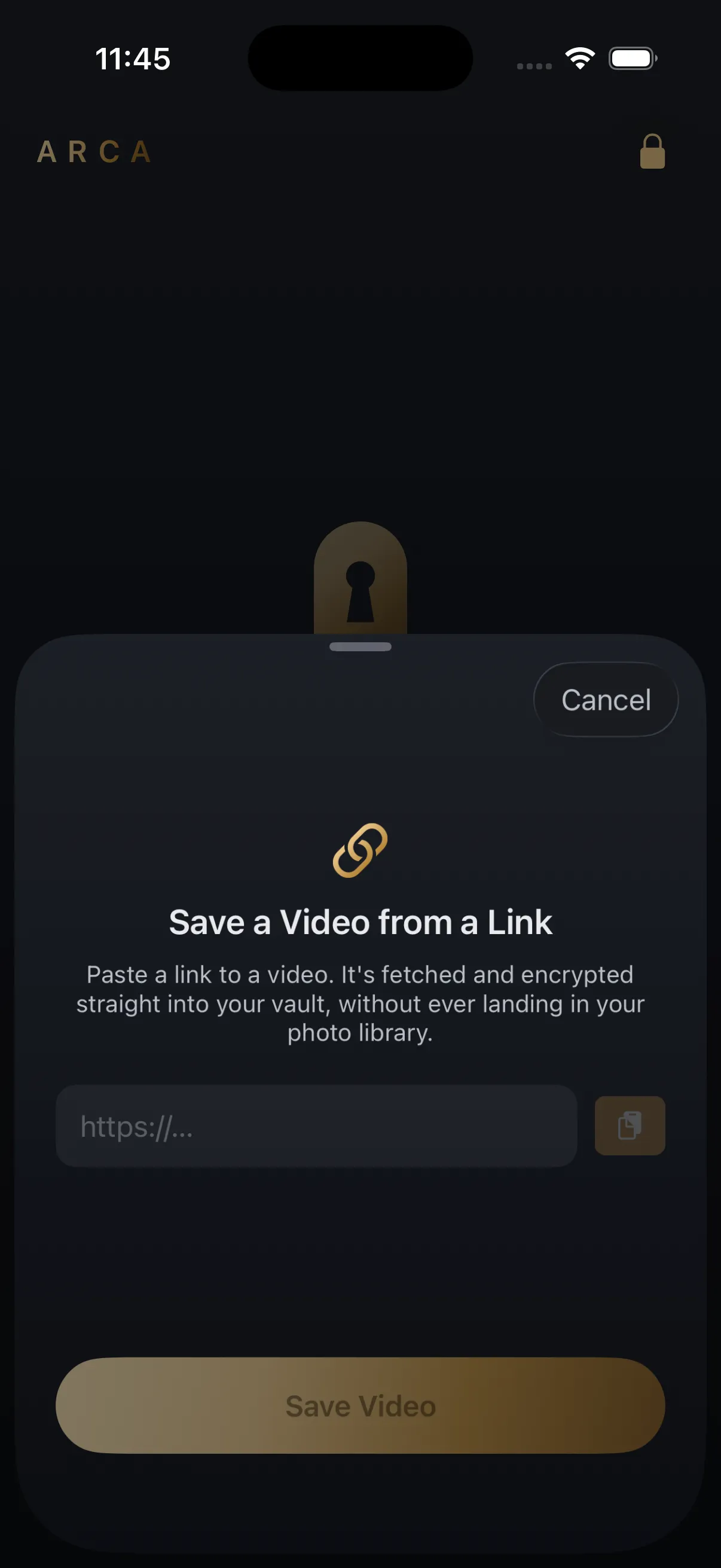
What lands is encrypted with AES-256-GCM on the device, under a key derived from your PIN with Argon2id. The vault has no account and no sync server behind it. Link downloads are a premium feature, and the app saves video, not audio-only files.
Save what you have the right to save: your own posts, content a platform allows you to save, public posts you want to watch offline. None of this is a route around private accounts, paywalls or age gates, and the platform’s terms still apply to you.
Frequently asked questions
Does a downloaded video contain my IP address? +
No. An IP address belongs to a network request, not to a video file. The server you asked for the file saw it at the time of the request, but there is nowhere in the container to write it and nothing writes it.
Can the original poster tell it was me from the file? +
Nothing identifying you is added to the file, so the file cannot tell them. Whether the platform itself reports anything to the uploader is a separate question, and on the major platforms a view is all they see.
Should I strip metadata before sharing a video I downloaded? +
It usually achieves nothing, because what is in there describes the source rather than you. Stripping matters for video you shot yourself, which can carry a creation date and sometimes a location.
Keep reading
Privacy
What Can Someone See With Your Apple ID?
Your Apple ID is the key to iCloud, not to your whole phone. Someone who signs in as you can reach what's synced to your account, and nothing that never leaves your device. Here's exactly where that line falls, and how to protect it.
Privacy
What Can a Repair Shop See on Your iPhone?
A hardware repair rarely needs your data at all, and a reputable shop won't ask for your passcode. The exposure comes from handing over an unlocked phone. Here's what a repair shop can actually see, and how to hand yours over with nothing to find.
Comparisons
Why the GIF You Saved Is a Video File
You asked for a GIF and got an MP4. That swap did not happen during the download. Platforms convert uploaded GIFs to silent looping video, so the GIF was gone long before you pasted the link anywhere.
Your photos. Truly private.
Download Arca and lock your first photos away in under a minute. No account, no cloud, no one but you.
Free to download · iPhone · iOS 18+