
Comparisons
Should You Store Private Photos in a Password Manager?
Password managers encrypt files properly, so storing a few sensitive photos there is a reasonable idea. It stops being reasonable at about a dozen photos, and the reasons are storage caps, workflow, and where the data lives. Here is the honest comparison.
Yes, you can, and the encryption is genuinely fine. 1Password and Bitwarden both store file attachments securely. The problem is fit rather than safety: storage caps, one-at-a-time import, and no way to browse images make it workable for a handful of documents and painful for anything resembling a photo library.
The short answer
If you want to keep a passport scan, an insurance document, and two or three sensitive photos somewhere safe, your password manager is a perfectly sensible place to put them. You already trust it with more valuable secrets, the crypto is well understood, and it’s one less app.
If you’re thinking of it as somewhere to keep private photos in any volume, it will frustrate you within a week. Not because it’s insecure, but because it was built to store secrets you retrieve occasionally, not images you look at.
That distinction is worth holding onto, because the security conversation and the usability conversation usually get mixed together here, and only one of them is a real problem.
How it actually works
Both major password managers support attaching files to items, and the mechanics are straightforward.
In 1Password, you create a new item of type Document and add the file to it, or attach a file to an existing item. Individual accounts include 1 GB of storage. In Bitwarden, attachments are a paid-plan feature, capped at 500 MB per file and 5 GB total per account, with a lower 100 MB limit when uploading from mobile. Bitwarden states that attachments are encrypted and decrypted locally, so no unencrypted attachment data travels to or sits on its servers.
Both approaches are sound. Your file is encrypted with the same machinery protecting your passwords, which is machinery that gets audited and attacked by professionals and holds up. Nobody should hesitate on cryptographic grounds.
There is one consequence worth thinking through, though, and it has nothing to do with the algorithms. Photos stored this way inherit your unlock habits. Most people set their password manager to open with Face ID and to stay unlocked for a stretch afterwards, because typing a long master password forty times a day is intolerable. That’s a sensible setting for passwords, where each retrieval is a deliberate act. It means the photos are reachable during that same window, on an unlocked phone, by whoever is holding it. Not a flaw in the product, just a mismatch: the convenience settings were tuned for a different kind of secret.
The storage math nobody mentions
Capacity is where the idea starts to strain, and it’s easy to check with arithmetic rather than opinion.
A typical photo from a recent iPhone, saved as HEIC, lands somewhere around 2 to 4 MB. That means 1 GB of included storage holds a few hundred photos in the best case. Shoot in ProRAW and a single frame can pass 25 MB, so the same allowance disappears in a few dozen shots. Video isn’t worth discussing at these tiers; a couple of minutes of 4K will eat a meaningful fraction of everything you have.
Compare that to what people actually mean when they say private photos. Even a modest set is hundreds of images. A password manager’s storage was sized for documents, recovery codes, and the occasional scan, and it behaves exactly as you’d expect when you ask it to hold a photo collection.
Where the friction really shows up
Capacity is the obvious limit. Workflow is the one that makes people give up.
- Import is one file at a time. There’s no select-200-and-move. Every photo is a separate item creation, and doing that fifty times is not a thing anyone finishes.
- There’s no grid. Password managers show you a list of item names. Finding a photo means remembering what you called it, or opening items one by one to look.
- Viewing is slow. Open the item, open the attachment, wait for the preview. It’s fine once. It’s miserable when you’re looking for a specific shot.
- Nothing strips metadata. The file goes in exactly as it came out of Photos, location data included, and it comes back out the same way when you share it.
- Deleting the original is still on you. Storing a copy in your vault does nothing about the copy sitting in your camera roll, or the one already synced to iCloud.
That last point catches people. Moving a photo somewhere safe is only half the job; the original has to go, and no password manager helps with that step.
Sharing has the same shape of problem in reverse. To send one of these photos to someone, you export the attachment, which drops a decrypted copy into Files or your camera roll, and then you share it from there. That copy doesn’t clean itself up. Every time you use a photo you’ve stored this way, you create a new unprotected version and take on the job of remembering to delete it. Do that a few times and the careful thing you set up quietly stops being true.
The architectural difference worth understanding
Beyond capacity and convenience, there’s a structural difference that matters depending on what you’re worried about.
A password manager is sync-first by design. Your encrypted data lives on the company’s servers so it can appear on your laptop, your phone, and a browser. That’s a real feature. It also means an encrypted copy of your photos exists somewhere you don’t control, protected by your master password and the provider’s implementation.
An on-device vault takes the opposite position. Nothing leaves the device, so there’s no server to breach, no account to compromise, and nothing to hand over in response to a legal request. The cost is equally real: no automatic sync between devices, and no recovery if you forget your passphrase, because there’s nobody holding a copy.
Neither is universally correct. Which one you want depends on whether you’re more worried about losing access or about a copy existing elsewhere. We walk through that trade-off in more depth in on-device vs cloud encryption for photos.
Side by side
| Password manager | On-device photo vault | |
|---|---|---|
| Encryption quality | Strong, mature, audited | Strong if implemented well |
| Where data lives | Provider’s servers, encrypted | Only on your device |
| Sync across devices | Yes, automatic | No, by design |
| Recovery if you forget | Account recovery options exist | None, the data is gone |
| Bulk import from camera roll | No | Yes |
| Browse as a photo grid | No | Yes |
| Practical capacity | 1 to 5 GB, document-sized | Limited by phone storage |
| Video | Impractical | Depends on the app |
| Metadata handling | None, file stored as-is | Varies by app |
| Decoy or duress option | No | Some apps offer one |
Read that table as a fit chart rather than a scoreboard. The password manager column is exactly right for a dozen sensitive documents, and exactly wrong for four hundred photos.
When a password manager is the right answer
There are genuine cases where adding another app would be the wrong move.
- You’re storing documents, not photos. Passport scans, insurance paperwork, recovery codes, a photo of your car’s VIN. This is what the feature was built for.
- The count is small and stable. Under a dozen items you’ll never need to browse.
- You need them on multiple devices. Sync is a real advantage and on-device vaults deliberately don’t offer it.
- You want recovery options. If losing access is scarier than a provider holding an encrypted copy, that’s a reasonable position.
- You don’t want another app. Fewer tools is a legitimate security preference in itself.
When a dedicated vault fits better
The other side is just as clear-cut.
- You have more than a handful of photos. The moment browsing matters, a list of item names stops working.
- You want to move things in quickly. Bulk import from the camera roll is the difference between doing this and intending to do it.
- You’d rather nothing left the device. No server, no account, no remote copy.
- You want the originals dealt with. A vault that imports and removes closes the loop that a manual copy leaves open.
- You might be asked to unlock. Some vaults offer a decoy, and a password manager has no equivalent.
If you’re still weighing the options in general, we compared the full range in where to store private photos on iPhone.
Where Arca fits
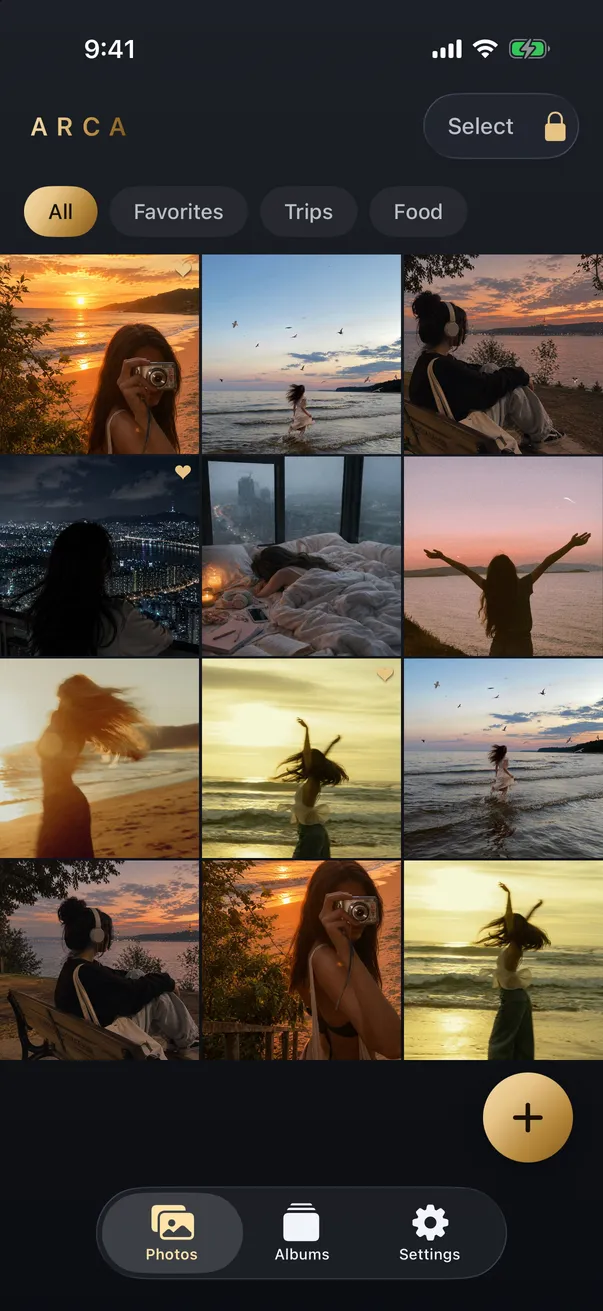
Arca is built for the case a password manager handles badly: photos in volume, kept on the device. Each one is encrypted with AES-256-GCM, and the key comes from your PIN through Argon2id, a deliberately slow key-derivation function that makes guessing that PIN expensive rather than instant. Everything stays in the app’s own container, with no server and no account, so there’s no cloud copy and nothing on our side that could be breached or requested. For situations where you might be pressured to unlock, there’s a decoy vault. The whole model is on our security page.
The honest limits, because a comparison piece that only lists advantages isn’t worth reading: no server also means no sync, so your vault lives on one device and doesn’t follow you to a laptop. It means no recovery either, so if you forget your PIN the photos are gone and you should keep your own backup of anything irreplaceable. It protects photos at rest, not while the vault is open in front of someone. And it protects what you actually move into it, not what’s still sitting in the camera roll.
Keep your documents in your password manager. It’s good at that. Photos in any number want something built for them.
Get Arca on the App Store to keep your private photos encrypted with AES-256-GCM on your device, with no server in the loop.
Frequently asked questions
Can you store photos in 1Password or Bitwarden? +
Yes, both support file attachments and both encrypt them properly. In 1Password you create a Document item and add the file, with 1 GB of storage included on individual accounts. Bitwarden allows attachments on a paid plan, up to 500 MB per file and 5 GB in total, and states that attachments are encrypted and decrypted locally so no unencrypted data reaches its servers. The encryption is not the weak point here.
How many photos fit in a password manager? +
Fewer than you would guess. A typical iPhone HEIC photo runs roughly 2 to 4 MB, so 1 GB holds a few hundred images at best, and a single ProRAW shot can exceed 25 MB on its own. Video is impractical at any of these tiers. If you are storing a passport scan and a handful of documents, capacity is fine. If you are storing a part of your camera roll, you will hit the ceiling quickly.
Is a password manager or a photo vault more secure? +
Both can be sound, and they make different trade-offs rather than one being stronger. Password managers are mature, audited, and sync your encrypted data across devices through their servers, which is convenient and means an encrypted copy exists off your phone. An on-device vault keeps everything in the app's container with no server involved, so there is nothing remote to attack, at the cost of no automatic sync and no recovery if you forget your passphrase.
Keep reading
Comparisons
Can You Hide Photos in the Notes App? (vs a Photo Vault)
Locking a note is real, strong encryption, so hiding a photo in the Notes app genuinely works. But Notes isn't built to be a photo vault. Here's exactly what it protects, where it falls short, and when a dedicated vault fits better.
Comparisons
Google Photos Locked Folder vs a Photo Vault: Which Is Safer?
Google Photos Locked Folder hides sensitive photos behind Face ID, which is genuinely handy. But it isn't end-to-end encrypted, and backed-up photos sit on Google's servers. Here's how it compares to an on-device vault.
Comparisons
The Best Private Photo Vault Apps for iPhone in 2026
A balanced buyer's guide to private photo vault apps for iPhone, with the criteria that actually matter and an honest look at the tradeoffs.
Your photos. Truly private.
Download Arca and lock your first photos away in under a minute. No account, no cloud, no one but you.
Free to download · iPhone · iOS 18+