
Comparisons
Where Should You Store Private Photos? iCloud vs a Vault App vs Offline
iCloud is convenient, a vault app adds a separate lock, and offline storage is the most private. The right home for a private photo depends on what you are protecting it from. Here is how the four options really compare.
There is no single best place to store private photos, only the right one for what you are protecting against. iCloud is the most convenient and is backed up automatically. A vault app adds a separate lock for your most sensitive images. Fully offline storage is the most private of all. The trick is matching the photo to the threat, not chasing maximum secrecy for everything.
First, what are you actually protecting against?
“Private” means different things, and the best storage choice changes completely depending on which worry is yours. Before comparing options, it helps to name the threat.
- A casual snoop, like a friend scrolling your camera roll, is stopped by almost any lock.
- A lost or stolen phone needs a passcode and, ideally, a separate lock on the sensitive set.
- A cloud breach or account takeover is about whether your photos are readable if someone gets into your account or Apple’s servers.
- Legal or third-party access is about who, beyond you, holds the keys.
- Total loss, a phone dropped in a lake, is the opposite worry: not that someone sees the photo, but that no one can, including you.
Notice that the last one pulls against all the others. The more aggressively you lock photos away, the easier they are to lose for good. That tension is the whole reason this is a real decision and not just “pick the most secure option.”
Most people never separate these worries, and that is what leads to the two common mistakes: trusting the cloud with everything because it is easy, or hiding everything offline because it feels safe. Naming your actual threat first is what lets you avoid both. A holiday photo and a copy of your passport do not belong in the same place, and they were never going to.
The cloud, as most people use it
By default, iCloud Photos is a sensible, safe choice for ordinary pictures. Apple encrypts your photos while they travel and while they sit on its servers, so a random outsider cannot simply read them, and everything syncs and backs up without you thinking about it.
The detail worth understanding is who holds the keys. In the standard setup, Apple keeps the encryption keys for iCloud Photos. That is what lets Apple help you recover an account you are locked out of, and it is also what lets Apple produce your photos if it is legally compelled to. For the vast majority of people and photos, that is a perfectly reasonable trade: enormous convenience and a real safety net, in exchange for Apple being technically able to access the data.
It only becomes the wrong trade when a photo is sensitive enough that “Apple can technically access this” is a line you do not want to cross.
The cloud, locked down with Advanced Data Protection
This is the upgrade most people do not know they have. Advanced Data Protection is a free setting that turns on end-to-end encryption for the majority of your iCloud data, including iCloud Photos and iCloud Backup. With it enabled, only your trusted devices hold the keys, and not even Apple can read your photos, which also keeps them unreadable in the event of a server-side breach.
It is off by default and you have to switch it on, and there is one serious string attached: because Apple no longer holds a key, Apple cannot rescue you if you lose access. You are required to set up a recovery key or a recovery contact first, and from then on that responsibility is yours. A couple of other things, like Shared Albums and “anyone with the link” sharing, sit outside the protection, so they are not end-to-end encrypted even with the feature on.
For privacy-conscious people, turning this on is one of the highest-value switches on the whole phone. It moves iCloud from “encrypted, but Apple can access” to “encrypted, and only you can,” which is the model people usually assume they already have. If the idea of keys living only on your devices is new, our explainer on zero-knowledge encryption covers the principle.
A vault app for the sensitive few
Even with Advanced Data Protection, every photo in your library opens the moment your phone is unlocked. A vault app solves a different problem: it puts a separate lock around a specific set of photos, so the sensitive ones are not exposed just because the phone is.
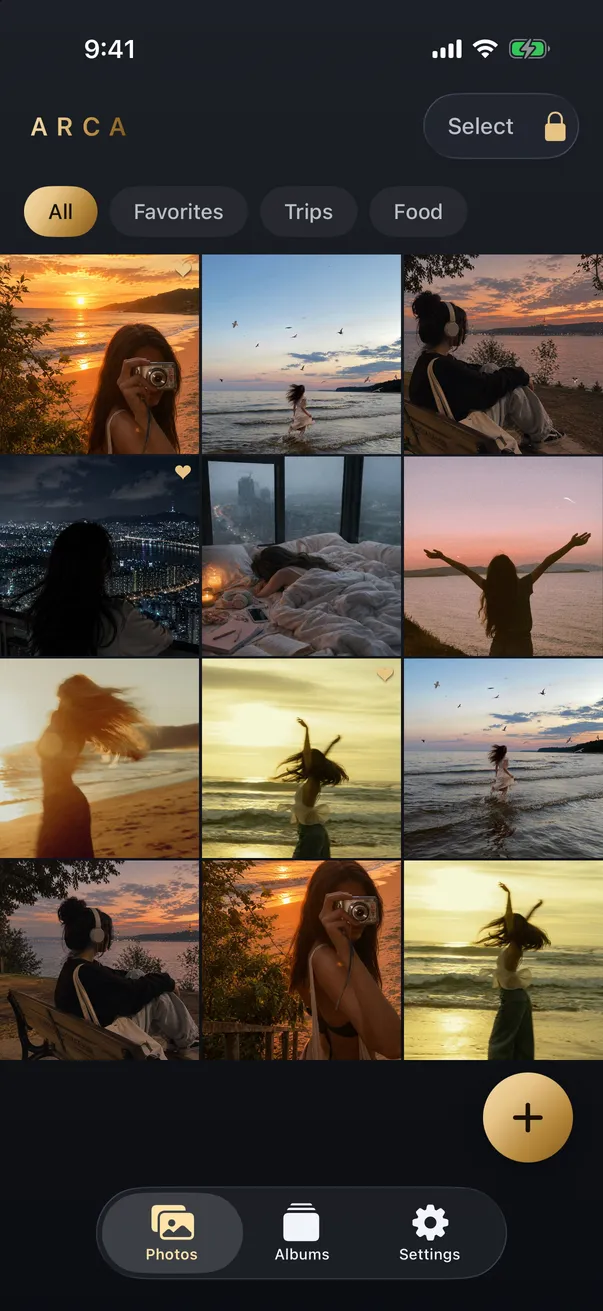
This is the model Arca uses, and it is worth being exact about what it does and does not do:
- Encrypted on the device. Photos in the vault are encrypted with AES-256-GCM, with the key derived from your passphrase using Argon2id. The vault opens with its own passphrase, separate from your device passcode.
- No server, no cloud copy. Arca uploads nothing, so there is no online account or company-held duplicate to breach or subpoena. The encrypted photos stay on your device.
- A decoy vault. A second passphrase opens a harmless set, which matters if you can be pressured to unlock the app.
What it does not do, stated plainly: because it keeps everything on the device and uploads nothing, it does not back your photos up for you. If the phone is lost and you have no separate backup, the vault contents are gone. It also cannot remove copies that already escaped to iCloud or elsewhere; it protects what you put in it from now on. If you want to weigh vault apps in general, we wrote about whether photo vault apps are safe.
Fully offline, for the truly private
The most private option is also the least convenient: keep the photo off any cloud and off your phone entirely. An encrypted copy on a computer or an external drive, disconnected from the internet, is about as close to unreachable as ordinary storage gets. Nothing syncs, nothing is uploaded, and there is no account to break into.
The cost is everything that makes the cloud pleasant. There is no automatic backup, no syncing across devices, and no recovery if the drive fails or is lost, so you genuinely must keep your own second copy. Offline storage is the right answer for a small number of truly sensitive files, and an exhausting way to manage your whole photo life. For the practical version of this, our guide on backing up private photos without trusting the cloud goes step by step.
What about Google Photos, Dropbox, and the rest?
Everything above centers on iCloud because it is the default on iPhone, but the same questions apply to any cloud. The one that matters most is always the same: who holds the keys? Most mainstream photo services, including Google Photos and standard Dropbox, encrypt your files on their servers while keeping the ability to access them themselves. That is what lets them power search, organize your library, and respond to legal requests, and it is not unusual or sinister. It simply means those services sit closer to “iCloud as it comes” than to “iCloud with Advanced Data Protection” on the privacy scale.
So if you rely on one of them, the move is the same as with iCloud. Use it freely for ordinary photos, and route the genuinely sensitive ones to a vault or to offline storage, rather than assuming the cloud’s encryption means the provider cannot see your pictures. The label “encrypted” tells you the data is scrambled in storage; it does not, on its own, tell you who can unscramble it.
The four options side by side
Laid out together, the tradeoffs are easy to see. No column is best at everything, which is exactly the point.
| iCloud (default) | iCloud + ADP | Vault app | Offline | |
|---|---|---|---|---|
| Can Apple access it? | Yes | No | Not uploaded | No |
| Automatic backup? | Yes | Yes | No | No |
| Convenience | High | High | Medium | Low |
| Separate lock for the sensitive set | No | No | Yes | Yes, by hand |
| Best suited to | Everyday photos | Privacy-minded everyday use | The sensitive few | The truly private few |
Read across and the shape is clear. The cloud options win on convenience and backup; the vault and offline options win on control and isolation. Most people do not have to pick just one.
So where should your private photos live?
The honest answer for most people is a layered one, not a single choice.
- Turn on Advanced Data Protection and let iCloud hold the everyday photos. This alone fixes the “Apple can access it” concern for your whole library and keeps the backup safety net.
- Put the genuinely sensitive few in a vault, so they carry their own lock and never touch the cloud, while the rest of your life stays convenient.
- Reserve fully offline storage for the rare files where even an encrypted cloud copy is more risk than you want, and accept that you are now your own backup.
That layering is the real takeaway. The mistake is treating it as one decision for every photo, either trusting the cloud with everything or trying to hide everything offline. Sort your photos by how much they actually matter, give each tier the home that fits, and you get convenience where you want it and control where you need it, instead of one blunt compromise that serves neither the holiday snapshots nor the handful of images you would never want anyone else to see.
Frequently asked questions
Is iCloud Photos safe for private photos? +
For most people it is reasonably safe, since iCloud encrypts your photos in transit and on Apple's servers. The nuance is that by default Apple holds the keys, so it can access your photos for account recovery or under legal process. Turning on Advanced Data Protection closes that gap by making the data end-to-end encrypted.
Does Advanced Data Protection encrypt my photos? +
Yes. With Advanced Data Protection switched on, iCloud Photos and iCloud Backup become end-to-end encrypted, so only your trusted devices hold the keys and not even Apple can read them. It is optional and off by default, and Apple makes you set up a recovery key or contact first, because if you lose access there is no one who can recover it for you.
Should I keep sensitive photos out of the cloud entirely? +
Only the genuinely sensitive ones, and only if you accept the tradeoff. Keeping a photo off the cloud removes the largest copy from anyone's reach, but you also lose automatic backup, so a lost or broken phone means a lost photo. A common middle path is iCloud for everyday photos and an encrypted on-device vault for the few that matter most.
Keep reading
Guides
Where Do Downloaded Videos Go on iPhone?
Three different places, depending on how you saved it, and they have very different privacy consequences. Here's how to find a video you've lost and how to decide where the next one lands.
Comparisons
Can You Hide Photos in the Notes App? (vs a Photo Vault)
Locking a note is real, strong encryption, so hiding a photo in the Notes app genuinely works. But Notes isn't built to be a photo vault. Here's exactly what it protects, where it falls short, and when a dedicated vault fits better.
Comparisons
iOS 18 App Lock vs a Photo Vault: Which Is More Private?
iOS 18 can lock the Photos app behind Face ID, so is a separate vault app still worth it? Here's exactly what the built-in lock does, where it stops, and when moving photos into an encrypted vault actually buys you more privacy.
Your photos. Truly private.
Download Arca and lock your first photos away in under a minute. No account, no cloud, no one but you.
Free to download · iPhone · iOS 18+