
Guides
How to Stop iPhone Photos From Syncing to iCloud
Want your photos off Apple's servers? Here is how to stop iPhone photos from syncing to iCloud without losing them, what actually happens to your existing library, and the trade-off you take on.
To stop your iPhone photos from syncing to iCloud, open Settings, tap your name, then iCloud, then Photos, and turn off “Sync this iPhone.” Choose “Download and Keep Originals” first so you don’t lose anything. From then on, new photos stay on your device instead of uploading to Apple’s servers.
Why turn off iCloud Photos syncing?
Most people leave iCloud Photos on without thinking about it, and for good reason: it backs up your library and keeps every device in sync. But there are honest reasons to switch it off, and privacy is the big one.
When iCloud Photos is on, a copy of every picture you take lives on Apple’s servers. That copy is convenient, but it’s also a second place your photos exist, one that can in theory be reached by a data request, an account breach, or anyone who gets into your Apple Account. Turning sync off means new photos simply stay on your phone, with no cloud copy created.
There are practical reasons too. You might be trying to free up iCloud storage, stop personal photos from appearing on a shared family Mac, or just prefer to keep your library on hardware you physically control. None of this requires panic. It’s a reasonable preference, and Apple makes it a setting you can change in under a minute.
Before you turn it off: download your originals
Here’s the step people skip and regret. If iCloud Photos has been optimizing your storage, the full-resolution versions of your photos may live only in iCloud, while your phone holds smaller previews. Turn sync off carelessly and you can be left with low-quality copies.
So do this first. Go to Settings > [your name] > iCloud > Photos, and if you see the option, select Download and Keep Originals. Give it time, ideally on Wi-Fi and while charging, to pull every full-resolution photo and video back down to your device. Only once that finishes should you turn syncing off. This one bit of patience is the difference between keeping your library intact and quietly degrading it.
How to turn off iCloud Photos, step by step
Once your originals are safely on the device, switching off sync takes a few taps.
- Open Settings and tap your name at the top.
- Tap iCloud, then tap Photos.
- Turn off Sync this iPhone (older iOS versions call this “iCloud Photos”).
- iOS will ask what to do with the photos currently on your phone. Choose Download Photos & Videos to keep full copies on the device, or Remove from iPhone if you’ve already saved them elsewhere and want the local copies cleared.
- That’s it. New photos you take from now on stay on the device and won’t upload.
If you have an iPad or Mac signed into the same account and you want them off the cloud too, repeat the same steps on each. Turning it off on just one device only changes that device.
What happens to your existing photos
This is where people get nervous, usually without cause. Turning off sync is not the same as deleting your library. Here’s what actually changes.
| What | After you turn off sync |
|---|---|
| Photos already on your phone | Stay on the device (full-res if you downloaded originals first) |
| Your existing iCloud library | Remains in iCloud and on other devices still syncing |
| New photos you take | Stay local, no longer upload to iCloud |
| Edits and deletions | No longer sync across your devices |
| Shared Albums | Stop updating; you keep what already downloaded |
One nuance worth knowing: if you stop using iCloud Photos entirely across your account, Apple keeps the uploaded copies for a grace period of about 30 days and then removes them, with an option to undo before that window closes. That’s another reason to download your originals first, so the only copy that matters is already safely on your own device.
iCloud Photos and iCloud Backup are not the same
A quick clarification that trips a lot of people up: iCloud Photos and iCloud Backup are two different settings, and turning one off doesn’t touch the other.
iCloud Photos is the library that syncs your pictures across devices in real time. iCloud Backup is the separate, once-a-day snapshot of your whole phone. Here’s the part that matters: when iCloud Photos is on, your pictures live in that photo library and aren’t duplicated in the device backup. When you turn iCloud Photos off, your local photos can then get swept into iCloud Backup instead, if you have that enabled.
So if your goal is to keep photos off Apple’s servers entirely, turning off iCloud Photos is only half the job. Check Settings > [your name] > iCloud > iCloud Backup as well. You can leave iCloud Backup on for everything else and simply understand that, with Photos sync off, your camera roll now rides along in that backup, or turn it off and handle backups yourself. Either choice is fine, as long as you know which one you’ve made.
Getting rid of the copies already in iCloud
If you also want the photos you uploaded before today gone from Apple’s servers, turning off sync alone won’t do it, since those copies simply stay put. You have two clean options.
The tidy way is to do it before you switch sync off, while iCloud Photos is still on. Because everything is synced, deleting a photo on your phone also removes it from iCloud, and the reverse is true too. Clear out whatever you don’t want the cloud to hold, empty Recently Deleted, and only then turn sync off. Alternatively, sign in at iCloud.com and delete from the web library there. Just make sure your originals are already downloaded to your device first, so “delete from iCloud” never turns into “delete everywhere.”
The trade-off: you’re now the backup
Switching off iCloud Photos buys you privacy and control, but it takes something away too, and it’s worth being clear-eyed about it. iCloud Photos wasn’t just syncing; it was quietly backing up your entire library. Turn it off and that safety net is gone.
From now on, if your phone is lost, stolen, or broken, the photos that only exist on it are gone with it. So the moment you stop syncing to iCloud, backing up becomes your job. Copy your library to a computer, an external drive, or another backup you trust, and do it on a schedule rather than “eventually.” We walk through solid options in how to back up private photos without trusting the cloud. If you’re weighing where your photos should live in the first place, iCloud versus a vault versus offline lays out the choices side by side.
What turning off sync does not do
It’s easy to assume that pulling your photos off the cloud makes them private, full stop. It doesn’t, and the gap matters.
Turning off iCloud Photos stops the cloud copy. It does nothing about who can open the Photos app on your phone. Anyone holding your unlocked device, or anyone who knows your passcode, can still scroll your entire camera roll, because it opens with the same passcode that unlocks the phone. The built-in Hidden album doesn’t change that either.
It also doesn’t retroactively erase what’s already in iCloud. The library you uploaded before today stays there until you delete it yourself. And if you’d rather keep the cloud’s convenience but close the privacy gap, Apple’s Advanced Data Protection end-to-end encrypts your iCloud Photos so not even Apple can read them, which is a different route to a similar goal.
For sensitive photos: off the cloud and behind a lock
For the handful of photos you’d never want a stranger to see, the strongest setup combines both ideas: keep them out of the cloud and behind their own lock on the device. That second lock is exactly what a vault is for, and it’s worth being precise about what it does.
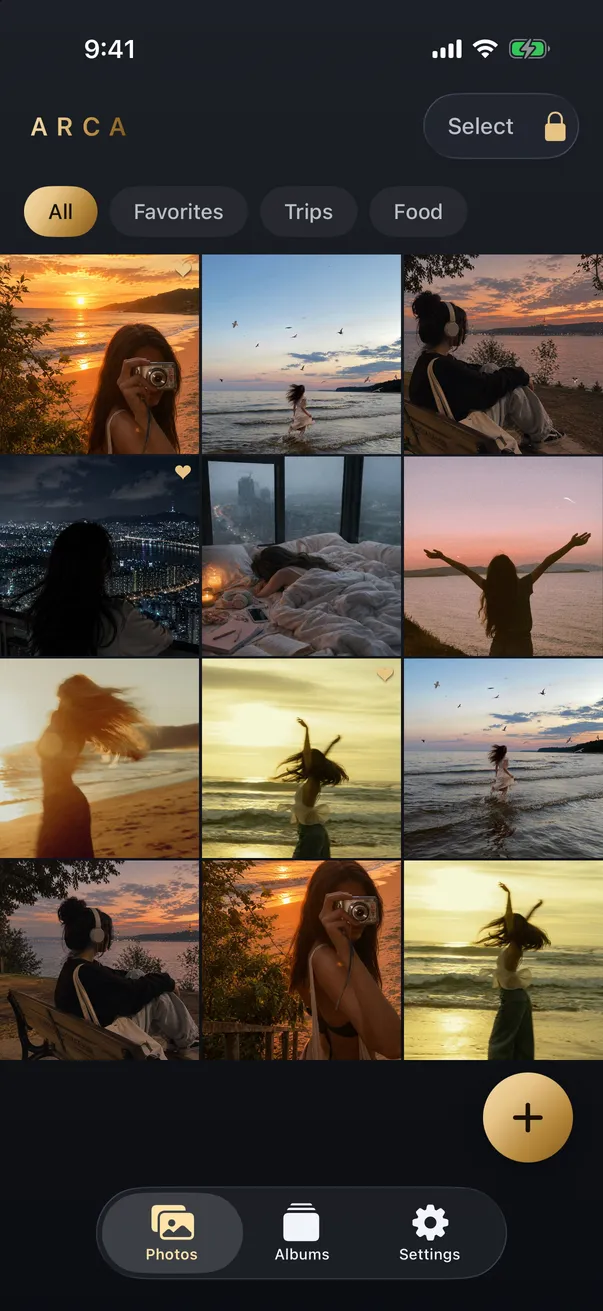
Arca keeps a chosen set of photos in an on-device vault encrypted with AES-256-GCM, where the key is derived from your PIN using Argon2id, a slow function that makes guessing the PIN expensive. There’s no server and no account, so nothing is uploaded and there’s no company-held copy to breach or hand over. A separate PIN means someone in your unlocked phone still meets a locked door, and a decoy vault can open a harmless set under a second PIN if you’re ever pressured to unlock it.
What Arca does not do, stated plainly: it doesn’t manage your iCloud settings for you, it does nothing for photos you leave in the regular camera roll, and no lock protects a vault you willingly open under duress, which is the whole reason the decoy exists. Turning off iCloud sync and moving the sensitive few into a vault are two separate, complementary steps: one keeps your library off Apple’s servers, the other keeps the photos that matter most locked even when your phone is not.
Stopping iCloud sync is a genuinely useful privacy move, and it takes about a minute once your originals are downloaded. Just remember what it does and doesn’t buy you: it takes your photos off the cloud, it hands you the backup job, and it leaves the on-device lock to you. Do those three in the right order, download your originals, decide how you’ll back up, and lock what truly matters, and you get the privacy without the accidental data loss that catches everyone who rushes it.
Frequently asked questions
Does turning off iCloud Photos delete my photos? +
Not from your device, as long as you choose Download and Keep Originals first, which saves full-resolution copies locally. Your existing photos also stay in your iCloud library and on your other devices. Only new photos stop uploading, so download your originals before you switch it off.
Will my photos still be in iCloud after I turn off syncing? +
Yes. Turning off iCloud Photos on one iPhone stops that device from syncing, but the library you already uploaded stays in iCloud and on any other devices still using it. If you want the cloud copies gone, you have to delete them from iCloud yourself, on a device or at iCloud.com.
Is it safer to turn off iCloud Photos? +
It is a trade-off. Keeping photos off iCloud means there is no cloud copy for anyone to breach or request, which is a real privacy gain. But you also lose Apple's automatic backup and cross-device sync, so you become responsible for backing up your own photos from then on.
Keep reading
Guides
Where Do Downloaded Videos Go on iPhone?
Three different places, depending on how you saved it, and they have very different privacy consequences. Here's how to find a video you've lost and how to decide where the next one lands.
Guides
How to Lend Your iPhone Without Anyone Snooping
Guided Access locks your iPhone to a single app, so the person borrowing it can't wander into Photos or Messages. It takes a minute to set up, and there is one trick that limits them to a single photo. Here is the setup, plus an honest account of what it doesn't cover.
Guides
How to Wipe Your iPhone Before Selling It
Selling or trading in your iPhone? Here's how to erase it so your photos and data are gone for good, why an iPhone reset is genuinely secure, and the one step people forget that leaves a copy behind.
Your photos. Truly private.
Download Arca and lock your first photos away in under a minute. No account, no cloud, no one but you.
Free to download · iPhone · iOS 18+